
A size label is a marketing decision. A tape measure is not. Two garments both printed with an L can differ by three inches across the chest and two through the shoulder — the difference between a piece that hangs the way it was drawn and one that reads as a mistake. Learn four numbers, and you can buy accurately from any brand.
Why four numbers beat a size label
Streetwear sizing drifts more than any other category. A brand cutting a boxy silhouette builds three or four extra inches into its medium; a brand cutting a classic tee does not. The letter on the tag describes the brand's intention, not your body.
Garment measurements do compare. They are taken flat, from fixed points on the pattern, and they are the numbers the factory worked to. Once you know your favorite tee measures 22 inches across the chest and 28 down the back, every size chart becomes readable. Our size guide publishes flat measurements for every cut we make.
Fit is not a feeling you develop over years. It is four measurements you can take in ninety seconds on a kitchen table.
Gifted Elite New York
The four measurements that actually matter
These four describe roughly ninety percent of how a top will sit. Everything else — rib depth, armhole height, collar width — only matters once they are right.
Chest, or body width
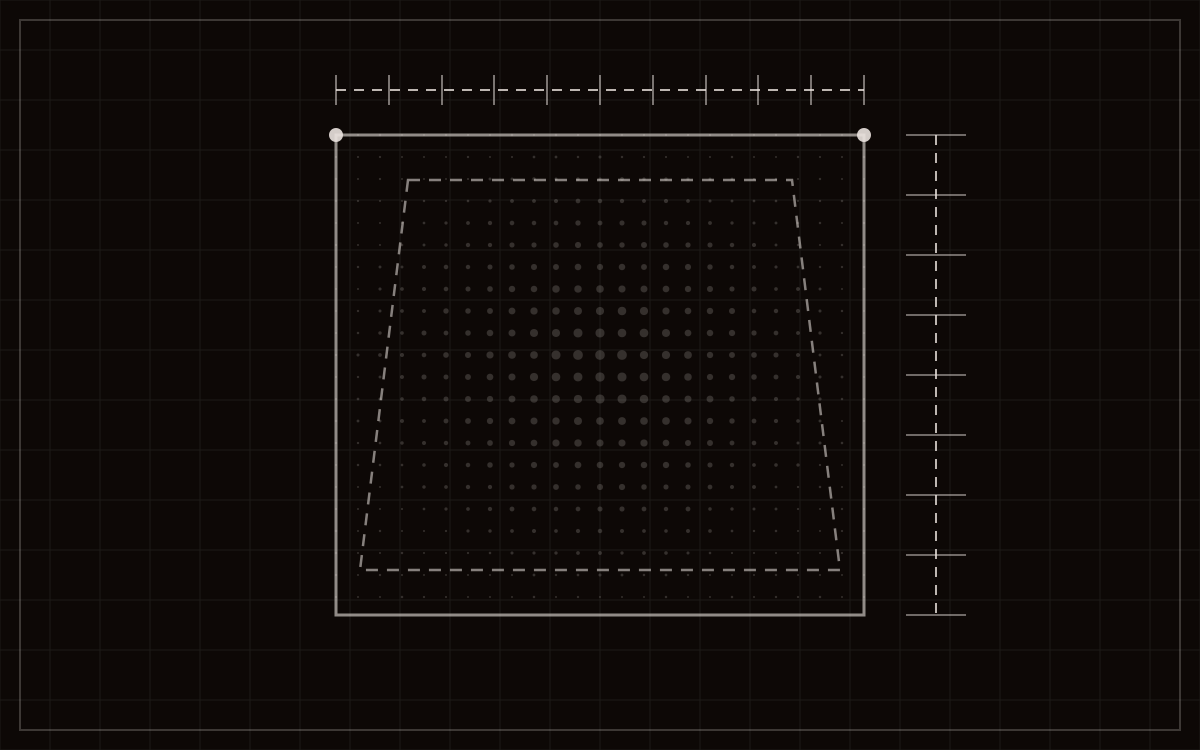
Taken across from one underarm seam to the other, garment flat and smoothed but not stretched. This is a half measurement: double it for the circumference. It controls how far the garment stands away from your torso — the biggest driver of whether it reads fitted, relaxed or oversized.
Body length
Taken from the high point of the shoulder — where the seam meets the collar, not the outer point — straight down to the hem. It decides where the garment lands relative to your belt, and it is the number most often ignored and most often responsible for a top looking wrong.
Across shoulder
Outer edge of one shoulder seam to the other, across the back. On a set-in shoulder it lands close to your own shoulder width; on a drop shoulder it deliberately overshoots, pushing the seam onto the upper arm. Get it wrong and no amount of correct chest width rescues the garment.
Sleeve length
Shoulder seam down the outside of the sleeve to the cuff. On drop-shoulder cuts some brands measure from the center back of the collar instead, producing a much larger number. Check which convention a chart uses.
Tape technique
Use a flexible tailor's tape, not a steel rule. Lay the garment on a hard flat surface, smooth it from the center outward, and let the fabric settle before reading. Never pull the tape tight across a knit — a heavyweight jersey gives half an inch under tension.
Measuring a garment you already own
The fastest route to accurate buying is a reference garment: the piece you would replace immediately if it were lost. Measure it once and buying becomes arithmetic — anything within half an inch on all four numbers will feel familiar.
- Choose the reference. Make sure it has been washed at least three times, so you measure settled dimensions rather than factory ones.
- Lay it flat and square. Front up, zip closed, sleeves out, hem straight. Press the seams flat; any twist distorts every number.
- Take chest width. Underarm seam to underarm seam in a straight line, recorded as a half measurement.
- Take body length. High point of shoulder to hem, following the body rather than draping over the chest.
- Take across shoulder. Outer seam to outer seam across the back.
- Take sleeve length. Shoulder seam to cuff, sleeve laid straight.
- Record it. Save all four in your phone in inches and centimetres.
What boxy, relaxed and oversized actually mean
Product copy uses these words interchangeably, but in pattern terms they are different levers. Ease is the gap between the garment's chest circumference and your own. Boxy is a ratio decision, oversized an ease decision, drop shoulder a seam placement.
| Fit name | Chest ease (full) | Shoulder seam | Body length | Reads as |
|---|---|---|---|---|
| Classic | 4–6 in / 10–15 cm | At the point | Standard | Clean, close to the body |
| Relaxed | 6–9 in / 15–23 cm | At or just past | Standard | Easy without looking borrowed |
| Boxy | 8–11 in / 20–28 cm | At or just past | 1–2 in / 2.5–5 cm shorter | Square; width close to length |
| Drop shoulder | 6 in and up / 15 cm and up | 1.5–3 in / 4–8 cm past | Standard or longer | Soft, rounded upper body |
| Oversized | 11–16 in / 28–41 cm | 2–4 in / 5–10 cm past | Standard or longer | Deliberate volume, columnar |
| Cropped | As base fit | As base fit | 2–4 in / 5–10 cm shorter | Higher waist break, longer leg line |
Boxy and oversized are not synonyms. A boxy tee can sit near your normal width and simply be cut shorter; an oversized tee can be long and wide and still read narrow if the shoulder seam has not moved.
Proportion, ratio and how an inch reads
Think of a top as a rectangle: chest width against body length. On a classic tee that ratio sits near 0.78 — 22 inches wide against 28 long. Push width to 24 and hold length, and it moves to 0.86, which the eye reads as square. That is the trick behind boxy.
An inch is not a rounding error. One inch of length moves the hem from covering your belt to sitting on it; one inch of width separates fabric that skims the ribs from fabric that stands away. Two inches changes the category, so between sizes you choose between silhouettes, not comfort levels.
Stagger the hems
Hems landing within an inch of each other read as one thick block. Aim for two to three inches of separation so the eye registers depth. If your hoodie is 28 inches long, the overshirt wants 30 or 31 — or decisively shorter, provided the gap is clear.
Sleeve stacking
Same logic at the cuff. A quarter to half an inch of base-layer sleeve past a sweatshirt cuff looks intentional; two inches looks accidental. Buy base layers with sleeves slightly longer than your mid layers.
Volume balance
Run one exaggerated volume at a time. A wide leg pairs with a top that is boxy but controlled through the shoulder; an oversized top pairs with a straight or lightly tapered leg. Two large volumes together read as costume, not proportion — the principle behind the layering order in the New York uniform piece.
Height and build
None of this is prescriptive, and every rule here is worth breaking on purpose. Under about 5'8", cropped and boxy tend to work better than long and oversized: a shorter body keeps the waist break high and the leg line unbroken. Over about 6'2", standard lengths finish too high — find pieces cut an inch or two longer rather than sizing up, which adds unwanted width.
Broad shoulders are served better by set-in or lightly dropped seams than by deep drops. A long torso is a length problem, not a width problem: hold the chest measurement and add length. Fix shoulder and length first; adjust width last.
Fabric, shrinkage and the between-sizes decision
Identical measurements in two fabrics produce two garments. A 400 gsm loopback holds its own shape and stands away from the body; the same pattern in 140 gsm jersey collapses onto it and reads a size smaller. Heavyweight cotton has the structure to hold a square; lightweight cotton needs a closer cut or more length. More in our piece on heavyweight cotton.
Shrinkage is the other variable. Ringspun cotton typically loses one to three percent in length and slightly less in width across its first washes, most of it in the dryer. Garment-dyed pieces have usually shrunk already.
A worked example
Your reference tee measures 22 inches across the chest, 28 long, 20 across the shoulder, 8.5 at the sleeve. You are considering a size L in a boxy heavyweight cut.
| Measurement | Reference tee | Candidate, size L | Difference | After a hot wash |
|---|---|---|---|---|
| Chest, pit to pit (half) | 22 in / 55.9 cm | 23 in / 58.4 cm | +1 in / +2.5 cm | 22.5 in / 57.2 cm |
| Body length | 28 in / 71.1 cm | 28.5 in / 72.4 cm | +0.5 in / +1.3 cm | 27.6 in / 70.1 cm |
| Across shoulder | 20 in / 50.8 cm | 21.5 in / 54.6 cm | +1.5 in / +3.8 cm | 21.3 in / 54.1 cm |
| Sleeve length | 8.5 in / 21.6 cm | 9 in / 22.9 cm | +0.5 in / +1.3 cm | 8.9 in / 22.6 cm |
Read it as a whole. The chest is an inch wider and the shoulder an inch and a half wider, so the seam sits down the arm: a real drop shoulder, not a hint of one. Length is shorter after washing, so the piece reads squarer than your reference. If that is the silhouette you want, buy the L; if not, check the M.
The between-sizes rule
Between two sizes, decide on the shoulder rather than the chest. A garment an inch too wide still hangs correctly; a shoulder seam in the wrong place cannot be fixed short of a re-cut. Size to the shoulder you want and accept the chest that comes with it.
Tailoring worth paying for
Two alterations return more than they cost. Hem shortening is cheap and transformative: an inch off a hem is the most efficient proportion change available. Sleeve taper on a jacket or overshirt, taking width out of the forearm while leaving the shoulder alone, cleans up a silhouette that reads sloppy. Do both after two washes. Skip the shoulder, armhole and chest of a knit — those cost more than the piece is worth. Shop the current cuts against your numbers.
The mirror and camera checklist
Numbers get you close; a mirror confirms it. Photograph yourself standing straight, arms down, full length — a camera is less forgiving and removes the posture corrections everyone makes unconsciously.
- Shoulder seam. At the point or a deliberate distance down the arm, not in between.
- Hem line. Clearly above or below your belt, not hovering across it.
- Chest drape. A clean vertical line, with no horizontal pull at the underarm.
- Cuff. Base layer showing by a deliberate amount, or not at all.
- Side profile. One volume, not two competing.
- Arms raised. Hem lifting no more than an inch or two; more means the armhole is too high.
Fix the shoulder first, the length second, the width last. Reversing that order is how good garments end up unworn.
Gifted Elite New York
Key takeaways
- Chest width, body length, across shoulder and sleeve length describe most of how a top sits.
- Measure a garment you already love and shop against its numbers, not size letters.
- Boxy is a ratio, oversized is an ease measurement, drop shoulder is a seam position — three different levers.
- One inch changes how a garment reads; two inches changes what it is. Between sizes, decide on the shoulder.
- Heavyweight fabric holds a boxy pattern; lightweight fabric collapses and needs a closer cut.
- Hem shortening and sleeve taper are worth paying for; shoulder and armhole alterations are not.
Frequently asked questions
Should I measure myself or the garment?
Measure the garment. Body measurements give you circumference and nothing else — not where a shoulder seam sits, not how long a hem runs. Flat garment measurements are what factories work to and what size charts publish, so they compare directly across brands. Take your chest once for reference, then work in garment numbers.
How much ease should an oversized tee have?
Roughly eleven to sixteen inches of total chest ease, or twenty-eight to forty-one centimetres, over your body measurement. Below that it reads relaxed; above it the armhole drops too low to layer under anything. The shoulder matters as much as the width, and should sit two to four inches past your natural shoulder point.
Will a heavyweight tee shrink enough to change size?
Rarely a full size, but enough to matter. Expect one to three percent loss in length and slightly less in width on untreated ringspun cotton, concentrated in the first few hot washes and dryer cycles. On a 28 inch body that is about half an inch. Wash cold and air dry to keep it.
What if I am between two sizes on your chart?
Choose on the across-shoulder measurement and the silhouette you want. Sizing up adds width, length and shoulder drop together, shifting the garment toward oversized; sizing down keeps it structured. If you want the width without the length, buy up and pay for a hem shortening — it is inexpensive and it works.