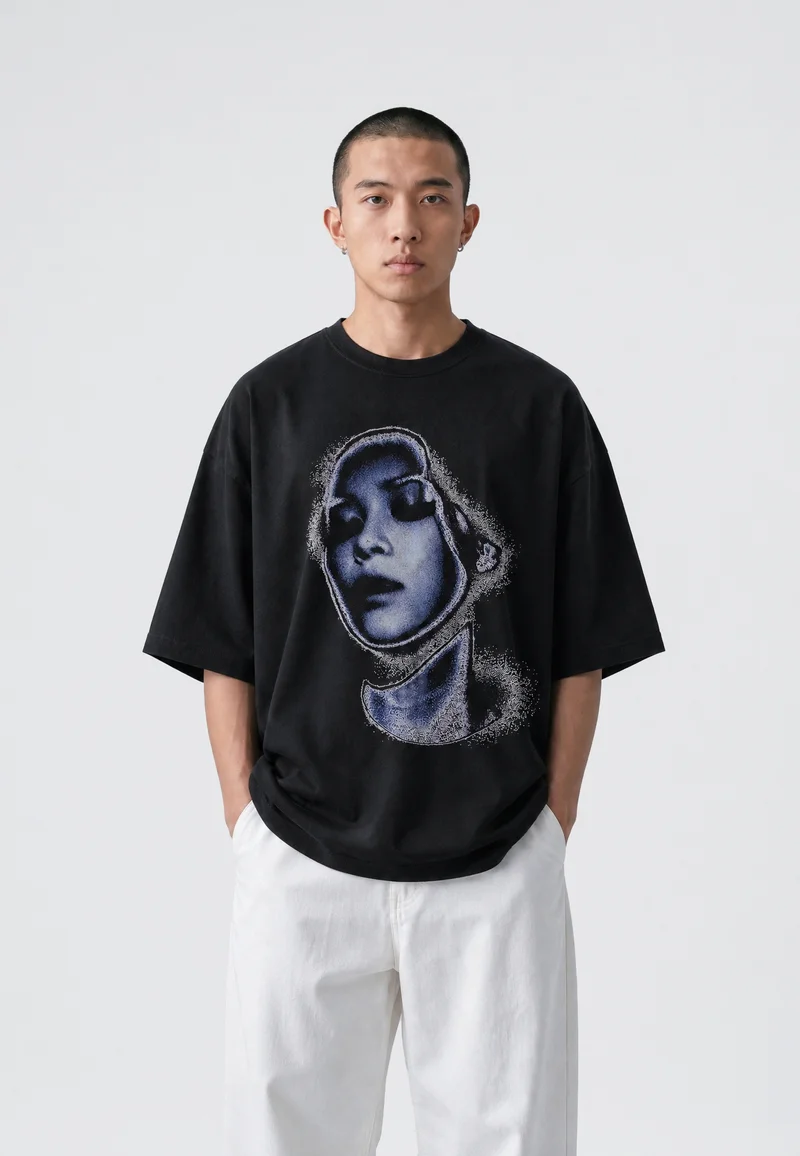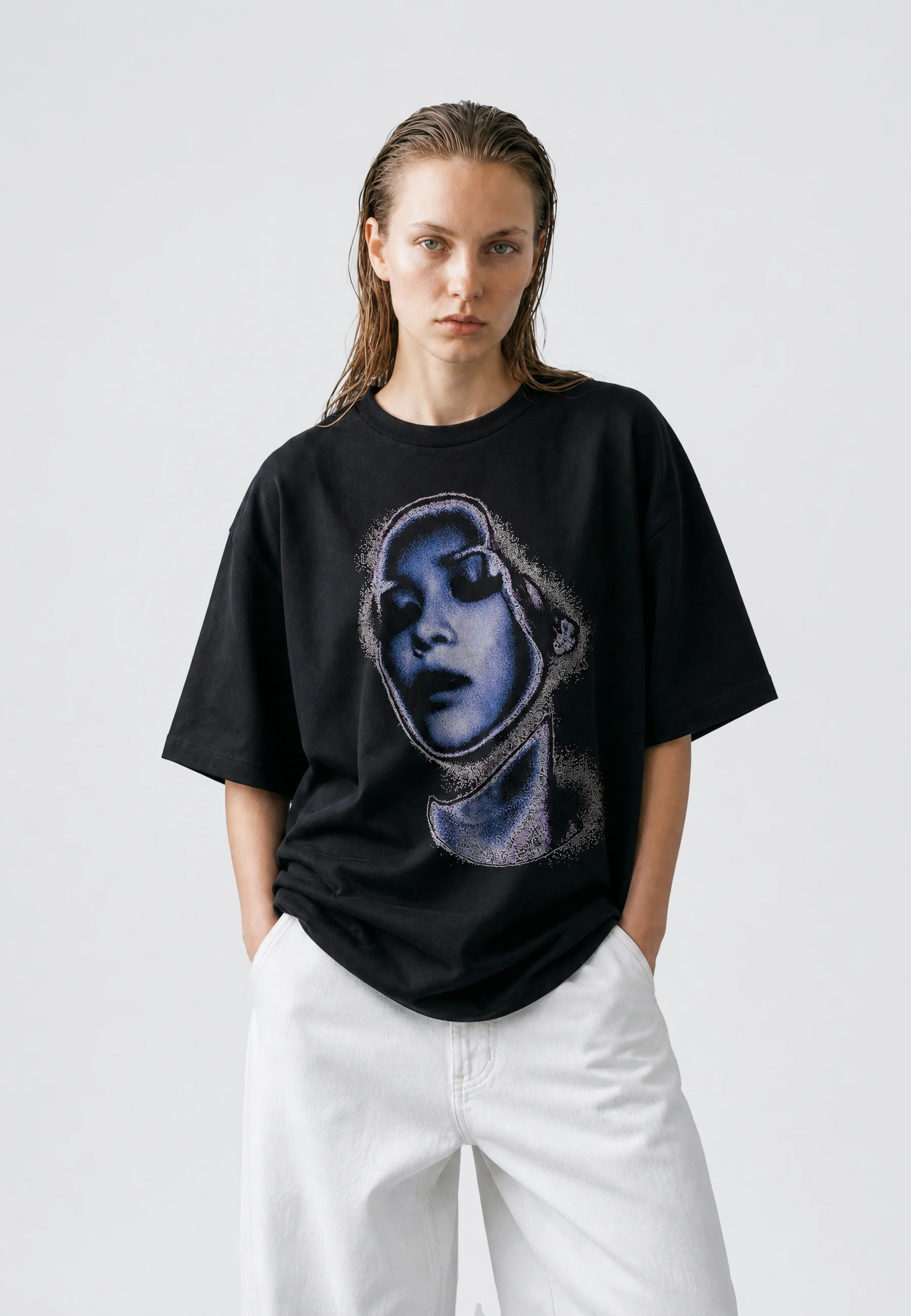
Every decorated garment is two products fused into one: cloth with its own weight and hand, and a layer of ink, thread or film sitting on it. The decoration decides how the piece feels, how it moves, and how it looks after forty washes. Most of what separates a good graphic from a bad one happens before anything touches the garment.
What decoration actually does to a garment
Ink and thread add mass, stiffness and a second set of care requirements. A heavy plastisol back print adds 40 to 60 grams to a tee and changes how the panel drapes. Dense chest embroidery pulls the fabric in two directions and needs backing to stop it puckering. That is the physical cost of the graphic, and the job is to spend it deliberately.
Three properties matter most. Hand-feel is what a thumb notices: whether the graphic sits inside the fabric or on top of it. Durability is how it survives abrasion, heat and detergent. Registration is how accurately colors line up. Scoring well on all three at low volume is expensive; the rest of this guide is which trade you are making.
Match the method to the cloth first
Fabric decides more than design does. Discharge and water-based inks need reactive-dyed cotton; they fail on polyester and most pigment-dyed garments. Sublimation needs light polyester. Dense embroidery needs a stable base. Know the blend, knit and dye method of the blank first — our guide to heavyweight cotton explains those specifications.
Screen printing: three ink families
Screen printing pushes ink through a mesh stencil, one color per screen, one pass per color. It stays the streetwear default because per-unit cost collapses at volume and color control is absolute. Setup costs the same for 12 pieces or 1,200, which is why small runs look expensive.
Plastisol
A PVC-based ink that sits on the surface and cures at roughly 320 °F. Opaque, sharp on fine detail, exact to Pantone, extremely durable. The trade is hand-feel: it is a plastic film, and a large solid area feels like one. Printed thin on a high mesh with a soft-hand additive it is nearly unnoticeable; printed heavy it cracks along fold lines within a few years.
Water-based
Pigment carried in water, which soaks into the fibers instead of sitting on them. On a light garment you cannot feel it at all, and it ages by softening rather than cracking. The limits: it needs a light base or an underbase to stay opaque, it dries in the screen if the press stops, and fine line edges are marginally softer than plastisol. It is also the cleaner option, for the reasons in our piece on sustainable production.
Discharge
A water-based system that removes the garment's dye instead of covering it. An activator strips black reactive-dyed cotton back to its natural tone, and pigment can ride in the same pass to land color in the bleached area. Hand-feel on dark cotton is the best available: zero. Tone varies by dye lot, and it fails on polyester and non-reactive dyes.
Specialty inks: puff, high-density, foil, flock
Puff is plastisol with a blowing agent that expands in the dryer, lifting the print one to three millimeters off the surface. It reads beautifully on bold shapes and destroys fine detail: anything under roughly 4 mm of line weight closes up as it rises. High-density uses a thick emulsion stencil to build a sharp raised block with vertical walls. Foil is printed adhesive with metallic film pressed on: the least durable common method, best kept to limited runs. Flock is short fiber on adhesive, velvet to the touch and prone to matting.
Ink is not free weight. Every gram you add to a panel is a gram the fabric has to carry for the life of the garment.
Gifted Elite New York
Digital printing and transfers
Digital methods skip screens, removing setup cost and making single pieces viable. They pay in per-unit price and usually longevity.
DTG sprays water-based pigment straight onto the garment from an inkjet head. On white cotton it is excellent and effectively invisible. On dark garments it needs a white underbase over a fixing pre-treatment, which stiffens the print and can leave a faint square halo. Unlimited colors, no minimum, but cost per piece barely moves between 1 and 500 units.
DTF prints the same image onto film, coats it in adhesive powder, and heat presses it on. It works on almost any fiber, holds photographic color, and needs no pre-treatment — but leaves a plastic film with an edge you can feel. Good DTF survives 40 to 50 washes; cheap DTF peels far sooner.
Sublimation turns dye to gas that bonds inside polyester fibers: permanent, zero hand-feel, never cracks — but only on polyester, and only on light cloth, since it cannot print lighter than the base. It is the one realistic route to a true all-over print. Cut vinyl is solid film cut to shape and pressed on: right for names and numbers, wrong for detail.
| Method | Hand-feel | Durability | Cost: 25 vs 250 units | Best for |
|---|---|---|---|---|
| Plastisol screen | Film; felt on solids | Very high | High, then low | Bold graphics, exact color |
| Water-based screen | Soft, sits in cloth | High; softens | High, then low | Light garments, faded look |
| Discharge | None | Very high | High, then low | Dark reactive-dyed cotton |
| Puff / high-density | Raised, firm | High; crushes | High, then moderate | Bold shapes, logotypes |
| Foil / flock | Metallic or velvet | Low | High at any run | Limited runs, accents |
| DTG | Soft on white, stiff on dark | Moderate | Flat at both | Samples, photo art |
| DTF | Film with a felt edge | Moderate | Flat at both | Short runs, any fabric |
| Sublimation | None | Permanent | Moderate | All-over on polyester |
| Cut vinyl | Thick solid film | Moderate | Low, then flat | Names and numbers |
| Flat embroidery | Dense, slightly stiff | Highest | Moderate, then low | Chest hits, caps |
| 3D puff embroidery | Raised, structured | Very high | High, then moderate | Caps, block letters |
| Chenille / woven patch | Applied panel, hard edge | Very high if stitched | Moderate, then low | Varsity branding |
Embroidery, chenille and patches
Embroidery is thread stitched into the garment along a digitized machine path. It is the most durable decoration available: the graphic cannot crack or peel because it is part of the cloth. Cost follows stitch count, not color count, so a two-color design with heavy fill can cost more than a five-color outline. Setup is a one-off digitizing fee; repeat runs are cheap.
Its limits are resolution and scale. Below roughly 4 mm text becomes a lump of thread, gradients are impossible, and large fills turn heavy and expensive. Flat embroidery on a 340 gsm crewneck is close to permanent; on lightweight jersey it puckers unless backed properly.
3D puff embroidery stitches over a foam insert torn away at the edges, leaving a raised satin form. It suits caps and thick block letters, nothing subtle. Chenille — looped varsity yarn — is built as a patch and applied, giving real depth on heavy knits. Woven patches hold far more small-scale detail than stitching. Rubber patches keep sharp edges and survive anything, but are heat sensitive and must never be ironed.
Stitched beats fused, every time
A patch attached only with heat-activated adhesive will eventually lift at a corner, usually after a hot dryer cycle. One heat set for position and then stitched around the perimeter will outlast the garment. Look for that perimeter stitch on the inside face.
Choosing a method for a specific design
Start with the artwork, not the technique. The smallest feature and the color count set what is possible; quantity and budget narrow the rest.
| Artwork | Use | Avoid | Reason |
|---|---|---|---|
| Fine line art, thin type | Plastisol screen, DTF | Puff, embroidery, flock | Raised methods close detail below 4 mm |
| Halftones and gradients | Water-based or plastisol screen | Cut vinyl, embroidery | Needs a dot pattern to hold tone |
| Big blocky logo | Puff, high-density, plastisol | DTG on dark cotton | Large solids show DTG stiffness |
| Photographic image | DTF, DTG, sublimation | Screen at low volume | Color separations get expensive fast |
| Small chest hit | Flat embroidery, woven patch | Foil, flock | Small areas take abrasion; thread survives |
| Full back print | Screen printing | DTG, cut vinyl | Big coverage needs a soft, breathable layer |
| All-over graphic | Sublimation | Any screen method | Only sublimation crosses seams |
Artwork prep that prevents most problems
Half of all print failures are file failures. The basics are simple.
- Work in vector. Logos, type and hard-edged shapes scale to any size without softening. Convert type to outlines before sending.
- Raster at 300 DPI at final print size. A 72 DPI file enlarged to fit is not the same thing, and no printer recovers that detail.
- Specify Pantone solid coated references. Ink is mixed to Pantone, not to your monitor, and shifts slightly on dark cotton over an underbase.
- Plan the underbase. On dark garments every color sits on a printed white layer. Choke it slightly inside the artwork edge so no white halo shows.
- Trap adjacent colors. Overlap touching colors slightly so a small shift on press cannot open a gap.
- Send a mock-up with placement and size. Give print width in inches and a measurement from the collar seam, never placement in words alone.
Washing, aging and how to spot quality
Some garments are washed after printing on purpose. An enzyme or stone wash softens the cloth and abrades the print, producing the broken look of a well-worn tee in one cycle. Done badly it thins the ink until the underbase shows. Pigment-dyed pieces are printed after dyeing so the graphic ages with the color around it.
Each method fails recognizably. Plastisol cracks along fold lines. Water-based and discharge fade evenly. DTF and vinyl lift at the corners. Foil flakes. Embroidery rarely fails itself — the fabric behind it gives out. Knowing the failure mode tells you what to protect against.
- Wash inside out, cold, gentle cycle, machine no more than two-thirds full.
- Skip fabric softener, bleach and optical brighteners.
- Hang or lay flat to dry; heat breaks films and mats flock.
- Never iron a graphic directly; press from the reverse or under a cloth.
- Turn caps and embroidered pieces inside out only if the structure allows it; otherwise spot clean.
To judge a finished garment, look at the edges and the reverse. A quality screen print has crisp outlines with no white halo, even density, and a graphic that flexes rather than crackles when folded. Good embroidery lies flat, has clean satin edges, and shows neatly trimmed backing inside. On a patch, check for perimeter stitching. Then check placement: a chest hit measured from the collar, a back print centered on the side seams. Those details are what the price on every piece in the collection pays for.
Key takeaways
- Screen printing wins on cost and control above roughly 50 units; digital and transfer methods win below it.
- Hand-feel ranks discharge and water-based first, sublimation and flat embroidery next, films last.
- Raised methods need bold shapes; nothing thinner than about 4 mm survives puff or high-density.
- Embroidery is the most durable decoration made, but cannot do small text, gradients or photographs.
- Fabric limits method: discharge needs reactive-dyed cotton, sublimation needs light polyester.
- Most failures start in the file — vector art, 300 DPI raster, a choked underbase and trapping prevent them.
Frequently asked questions
Why does the same design cost so much more for 20 pieces than for 200?
Screen printing has fixed setup costs: film output, one coated screen per color, and press registration. That work is identical whether the run is 20 pieces or 200, so on a short run it is spread across very few garments. Above roughly 50 units setup disappears into the per-piece price and screen printing becomes the cheapest option available.
Is a cracked print a defect or normal wear?
Both, depending on timing. Plastisol that cracks along fold lines after two or three years of wear is normal aging, and many people prefer the broken look. Cracking within the first few washes means undercuring — the ink never reached full temperature in the dryer. Ink that lifts away from the fabric in sheets is always a defect.
Can any design be embroidered instead of printed?
No. Embroidery cannot reproduce gradients, halftones or photographic detail, and text below about four millimeters becomes an illegible lump of thread. Large filled areas are possible but heavy, stiff and costly, since pricing follows stitch count. Simplify the artwork into solid shapes first, or choose a woven patch, which holds finer detail at small sizes.
Which method should I use for a one-off sample?
DTF in most cases. It needs no screens, works across cotton, blends and synthetics, holds full-color detail, and costs the same for one piece as for fifty. DTG is better if the garment is white cotton and you want a softer hand. Neither matches the Pantone or hand-feel of a screen-printed run, so treat a sample as a check on scale and placement.